Innovation in water management and strategic alliances mark the EU–LAC dialogue in Brasilia
- The international meeting highlighted the role of technology, cooperation, climate investments, and governance in transforming water management in agriculture across Latin America and Europe, with technical contributions from CATIE.
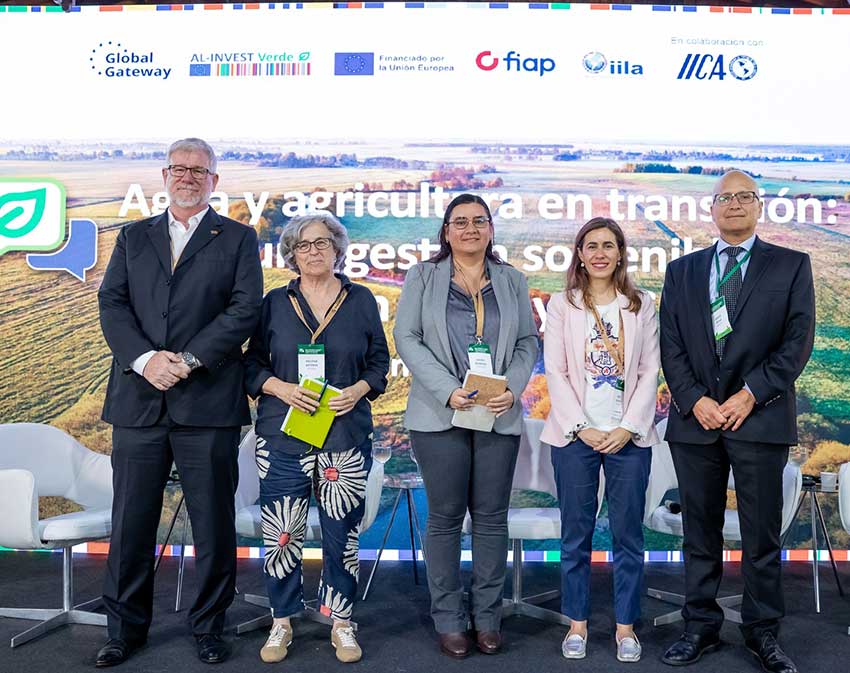
CATIE (Tropical Agricultural Research and Higher Education Center) participated in the IV Agro-food Dialogue “Water and Agriculture in Transition: Toward Sustainable and Resilient Management in the EU and LAC,” a high-level event organized under the European Union’s AL-INVEST Verde program, with support from the Inter-American Institute for Cooperation on Agriculture (IICA).
Representing CATIE, Laura Benegas, Director of the Division for Research for Inclusive Green Development (DIDVI) and Coordinator of the Watersheds, Water Security and Soils Unit (UCSHS), contributed her expertise in a space that brought together scientific leaders, public institutions, international organizations, and technology experts. Her contributions focused on innovations, investments, and strategic alliances to strengthen climate resilience of water resources in the agri-food sector.
Benegas participated in the official program by moderating the panel “Driving Technological Solutions for Sustainable Water Management in Agriculture,” where participants explored how innovation—including artificial intelligence—is accelerating water-use efficiency and supporting decision-making in production systems. The panel featured representatives from EMBRAPA (Brazil), the Spanish National Research Council (CSIC, Spain), the Polytechnic University of Madrid, and the company DIMITRA (Canada), creating new opportunities for scientific collaboration and technical cooperation.
During the dialogue, Benegas emphasized that “the key messages for the responsible deployment of technologies are transparency in the development of AI-based products, investment in data and monitoring, definition of clear metrics, and linking these technologies with public policies and markets, contributing to the challenge of producing more with less.”
The meeting agenda also addressed public policy trends for water resilience, including: restoration of the hydrological cycle; smart water economy (digitalization, measurement, and observation); and universal access to clean water through improved treatment and reduced water footprint.
Regarding financing, experts highlighted the need for innovative schemes such as blended finance, partial guarantees, (matching funds(, and the role of development banks—including experiences such as debt-for-nature swaps—to catalyze investments and reduce risks in agriculture, particularly under scenarios of climate variability.
Science–territory connection: technical visit to EMBRAPA Cerrado
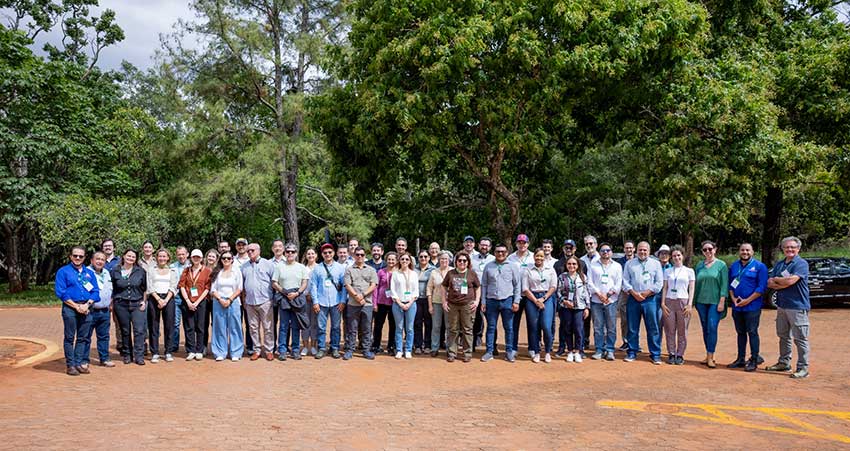
The program included a technical visit to EMBRAPA Cerrado to learn about experiences in efficient water use in agri-food systems and to develop public management guidelines through thematic roundtables. This space reinforced the importance of linking science, territory, and public policy to achieve sustainable impacts.
Toward a regional follow-up agenda
As a result of this participation, CATIE—through DIDVI and the Watersheds, Water Security and Soils Unit—will work together with IICA and institutional actors responsible for water and agriculture in Latin America and the Caribbean to build a follow-up agenda. The goal is to translate the technical–political dialogue into concrete opportunities for cooperation, applied research, and innovation for sustainable water management in agriculture.
More information:
Laura Benegas
Director, Research for Inclusive Green Development (DIDVI)
CATIE
laura.benegas@catie.ac.cr
Written by:
Karla Salazar Leiva
Communicator
Communications and Marketing Office
CATIE
karla.salazar@catie.ac.cr