European agricultural experiences drive sustainability in Latin America
- A European Union–funded project coordinated by CATIE analyzes the “leverage points” driving agricultural transformations in Europe—from local leadership to collaborative networks—to identify lessons that can strengthen the sustainability and resilience of agrifood systems in Latin America.
The world is simultaneously facing the climate crisis, biodiversity loss, and rising levels of pollution—challenges that directly affect agricultural producers and the viability of agrifood systems. In response to this scenario, the TRANSPATH project, funded by the European Union’s Horizon initiative and coordinated by the Environmental Economics and Sustainable Agribusiness Unit (UEAAS/EfD) of CATIE (Tropical Agricultural Research and Higher Education Center), works to identify “leverage points” capable of driving systemic changes toward sustainability.
Recent progress in the project offers insight into how farmers, communities, and local actors in different regions of Europe are building, through participatory approaches, the foundations for deep transformations, generating valuable lessons for Latin America.
Lessons from Europe
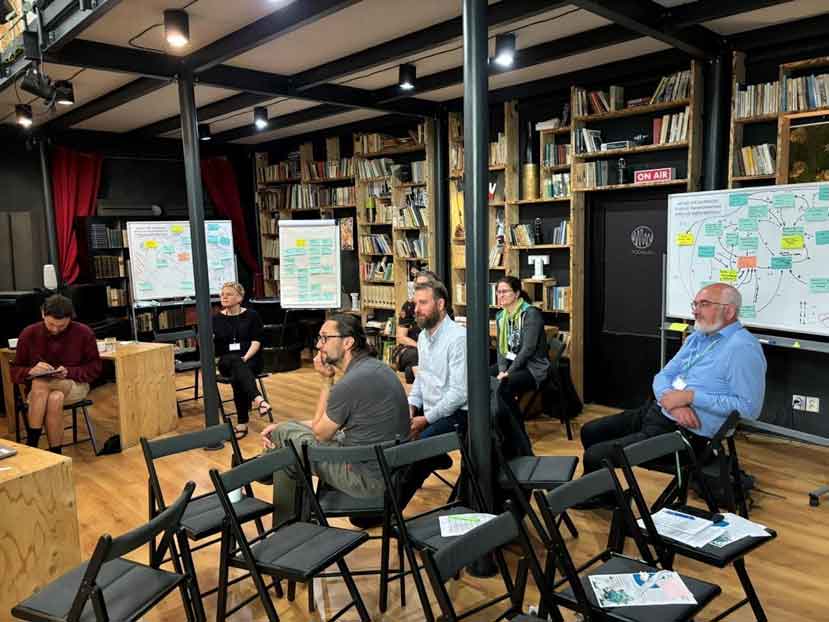
Preliminary results show that transitions do not occur abruptly; they often begin with specific actions tailored to the territorial context. In Eastern Europe (Czech Republic), representatives of initiatives and networks within the energy and food systems that support transformation noted that deep shifts toward sustainability often face social inertia and various forms of organizational resistance. Even so, they highlighted that cooperation, the formation of committed communities, and individual determination can open space for new sustainable trajectories.
In Western Europe (England), attention focused on farm clusters—networks of farmers collaborating on landscape-scale conservation. There, it became evident that even gradual adjustments can generate significant effects. The continuity of these networks depends largely on the ability of leadership to understand and respond to farmers’ priorities. The economic sustainability of local farms emerged as a shared objective that provides cohesion and guides collective action.
“Although they operate in different contexts, both cases show that leadership, community cohesion, and institutional trust are essential components for advancing toward more sustainable agricultural models,” said Pablo Evia, local coordinator of the TRANSPATH project and CATIE researcher.
How these findings resonate across continents
Although TRANSPATH centers its analysis on Europe, the lessons identified have the potential to inform transformation processes in other regions, such as Latin America. In this process, CATIE plays a key role, both in project coordination and in the development of the final synthesis of recommendations for decision-makers.
The work of the UEAAS/EfDhelps explore how elements driving transformation in Europe—such as place-based leadership or the importance of economic sustainability—could eventually be adapted to agricultural systems in the region, where distinct social, political, and environmental dynamics converge but comparable challenges persist, for example, in the face of climate change. This comparative exercise is important to assess the transferability of the mechanisms identified and anticipate the conditions under which they could operate in contexts characterized by different economic, institutional, or social pressures.
A bridge between local experiences and global ambitions
TRANSPATH’s advances provide a solid foundation for understanding how local actors interpret, negotiate, and drive changes within their own production systems. Collaboration with CATIE will make it possible to examine the applicability of these lessons in diverse contexts, enriching the comparative perspective and strengthening the usefulness of the findings for public policy formulation. In this effort, CATIE contributes its regional experience and its capacity to engage with local actors, ensuring that the knowledge generated can support sustainable transformations with global impact.
More information/written by:
Pablo Evia Salas
Researcher
Environmental Economics and Sustainable Agribusiness Unit (UEAAS/EfD)
CATIE
pablo.evia@catie.ac.cr