Launch of CATIE-led project to strengthen community-based water management in Latin America
- The research focuses on second-level organizations that articulate community water systems and strengthen community-based water management in rural areas.
With the firm objective of strengthening community-based solutions for water management in Latin America, CATIE (Tropical Agricultural Research and Higher Education Center) announces the official launch of its research project entitled Enhancing Rural Water Management Networks in Colombia and Costa Rica, funded by the Tinker Foundation.
The three-year study is led by CATIE’s Environmental Economics and Sustainable Agribusiness Unit (UEAAS/EfD) and is carried out in collaboration with Seattle University (United States) and Pontificia Universidad Javeriana (Colombia), strengthening a comparative and regional approach.
The main objective is to analyze and strengthen federations or second-level organizations that bring together community water systems. These providers of water for domestic consumption are key actors in the articulation, representation, and governance of water in rural areas.
Research rooted in the territory
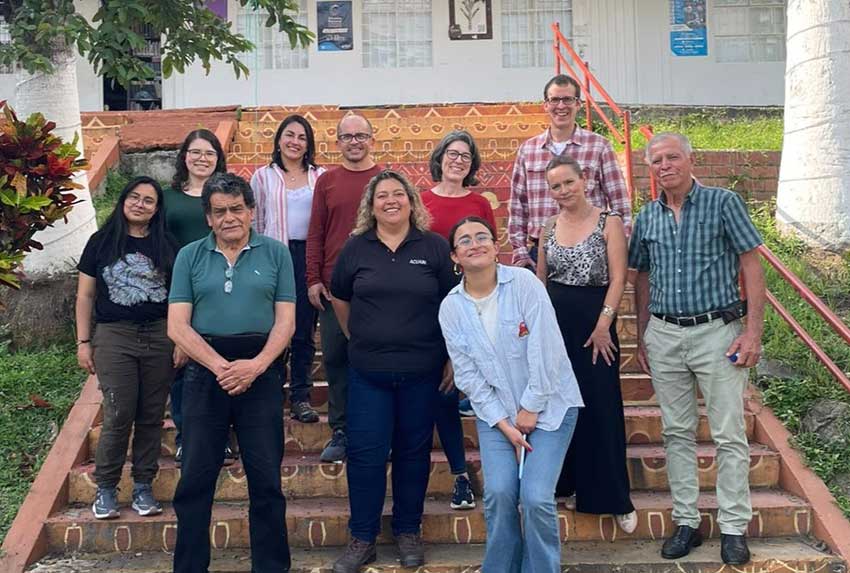
From January 19 to 22, 2026, the project’s research team met at the facilities of Pontificia Universidad Javeriana in Bogotá, Colombia, to formally launch field activities and establish the next steps for data collection.
During this mission, the team coordinated future actions with Esteban Moreno, president of the National Confederation of Community Organizations for Water and Sanitation Services of Colombia (COCSASCOL) and of the Association of Community Water Systems of Tena and Cundinamarca (ASATECUNDI), a second-level organization that brings together and represents multiple community water systems.
In addition, a meeting was held with representatives of water systems affiliated with ASATECUNDI, in order to understand their experiences, challenges, and needs related to water management, as well as the role played by second-level organizations in strengthening their technical, organizational, and advocacy capacities.
“The launch of this project represents a collective effort to listen firsthand to the realities of community water systems and the organizations that articulate them, in order to build, together with them, solutions that respond to their priorities,” commented Róger Madrigal, coordinator of the UEAAS/EfD and research lead at CATIE.
This project continues CATIE’s efforts to generate applied scientific evidence that contributes to strengthening local capacities and community-based water management networks, in the face of climatic and non-climatic threats that compromise access to safe drinking water in rural areas.
The research will focus on developing practical recommendations to expand the capacities of federations and generate inputs to guide governmental support and that of other organizations. Likewise, based on a comparative approach between Costa Rica and Colombia, lessons will be generated to promote sustainable water governance in other countries of the region.
More information/written by:
Róger Madrigal Ballestero
Coordinator
Environmental Economics and Sustainable Agribusiness Unit (UEAAS/EfD)
CATIE
rmadriga@catie.ac.cr
Written by::
Daniela Rivera
Research Assistant
Environmental Economics and Sustainable Agribusiness Unit (UEAAS/EfD)
CATIE
daniela.rivera@catie.ac.cr