Project ESCALAR presents research on coffee by-product valorization at the Wallace Conference 2026 at CATIE
- The study shows that coffee processing residues in the Trifinio Region could generate up to USD 56 million annually through circular bioeconomy pathways.
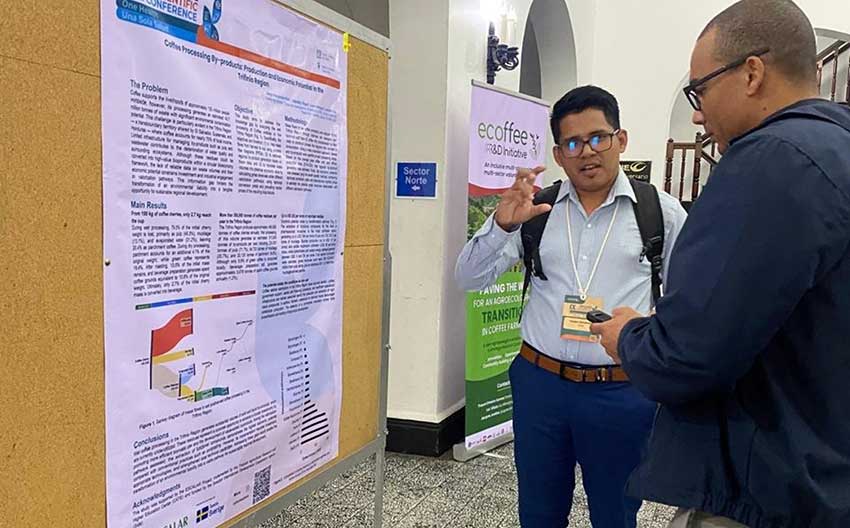
Within the framework of the Wallace Conference 2026, organized by CATIE (Tropical Agricultural Research and Higher Education Center), the ESCALAR Project: Scaling climate change adaptation solutions for resilience and migration reduction in the Central American Dry Corridor, funded by the Swedish International Development Cooperation Agency, presented the scientific poster entitled “Coffee processing by-products: production and economic potential in the Trifinio Region”; a study that analyzes the volume of waste generated along the coffee value chain and its potential as a source of sustainable economic development for the region.
The Wallace Conference is a platform designed to bring together leaders, academics, decision-makers, and professionals from the agroforestry and livestock sectors to address global health challenges under the One Health approach, promoting integrated solutions that connect production, the environment, and human well-being.
Beyond coffee: a circular bioeconomy opportunity
The study focuses on the Trifinio Region (a transboundary territory shared by El Salvador, Guatemala, and Honduras), where coffee accounts for nearly 70% of local income. However, wet coffee processing generates significant volumes of by-products that are currently underutilized and pose a high risk of environmental pollution.
Based on interviews conducted in 42 coffee processing facilities and mass flow analyses from harvest to cup, the research determined that:
- Of every 100 kg of coffee cherries, only 2.7 kg are converted into beverage.
- 79.5% of the initial weight of coffee cherries is lost during wet processing, mainly as pulp (45.3%) and mucilage (13.1%).
The Trifinio Region produces approximately 495,806 tons of coffee cherries per year, which generate more than 313,000 tons of by-products annually during processing.
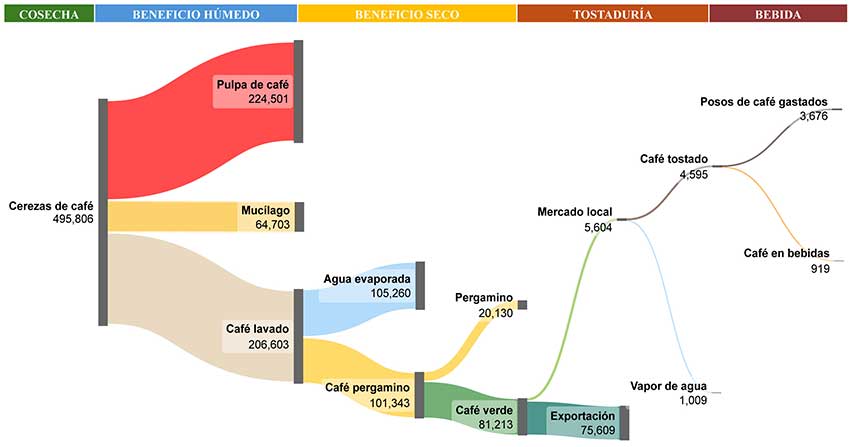
Figure 1. Mass flows during wet coffee processing in the Trifinio Region. Values are expressed in tons per year (Ton. year⁻¹).
By-products such as pulp, mucilage, and parchment could be transformed into high-value bioproducts for the cosmetic, pharmaceutical, food, and energy industries through circular bioeconomy schemes. Under this scenario, there is a wide range of opportunities that can contribute to income generation in the region while simultaneously reducing environmental pollution associated with coffee production.
Up to USD 202 per ton valorized
The analysis also identified that the most profitable pathway is the extraction of functional compounds, with potential revenues of up to:
- USD 194 per ton of pulp
- USD 202.6 per ton of mucilage
If all regional by-products were valorized, gross revenues could reach between USD 43.5 and 45.5 million annually from pulp alone, plus an additional USD 11.2 million from mucilage-derived products.
Other viable alternatives include biochar production, cultivation of edible mushrooms, and the generation of biofertilizers.
Investment and technology: a pathway for transformation toward territorial development
The findings show that coffee processing in the Trifinio Region not only presents environmental challenges but also a strategic opportunity to stimulate local economies, diversify income sources, and reduce ecological impacts.
However, advancing toward circular bioeconomy models in the region requires overcoming several structural barriers. Among the main challenges are the need to strengthen technical capacities, develop specialized industrial infrastructure, and improve access to financing—areas where processing facilities still face limitations. Likewise, it is essential to promote a shift in perspective: moving from a vision focused solely on environmental conservation to one that also incorporates the use and commercial valorization of waste.
Fernández Pérez, S.E. (2025). Analysis of the production and potential use of coffee residues for the development of bioproducts in biofactories in the Trifinio Region. Turrialba, Costa Rica, CATIE-Tropical Agricultural Research and Higher Education Center. Available at: https://repositorio.catie.ac.cr/handle/11554/14176
More information/written by:
Sergio Esau Fernandez
Graduate of the Master of Science (M.Sc.) in Economics, Development and Climate Change
ESCALAR Project - CATIE
Sergio.Fernandez@catie.ac.cr
Edición:
Arely Valdivia Araica
Communications Specialist
ESCALAR Project - CATIE
arely.valdivia@catie.ac.cr