From Drought to Resilience: The Story of Lesly and the First Zamorano Tank Built by ESCALAR in La Labor, Ocotepeque, Honduras
- ESCALAR presents the first of four life stories demonstrating that integrating climate adaptation and a gender approach in the territories of the Central American Dry Corridor in the Trifinio region go hand in hand.
The ESCALAR project: Scaling Climate Change Adaptation Solutions for Resilience and Reduced Migration in the Central American Dry Corridor promotes the mainstreaming of the gender approach in rural territories. Through technical assistance, policy advocacy, strengthening of associative rural enterprises, and climate financing, the project is working comprehensively to reduce the gender gaps prioritized in its Gender Strategy.
With this series of stories collected throughout 2025, ESCALAR presents experiences showing how women are expanding their participation in climate adaptation processes and positioning their contributions in the fight against climate change.
Lesly’s Story
“Building the Zamorano tank was one of the best opportunities. In our case, some of us handled the measurements, others said they didn’t know… I think the most beautiful part was the experience we had as a group. We learned. The first one was difficult because it was the learning process, but the second one was easier because we had done it before.”
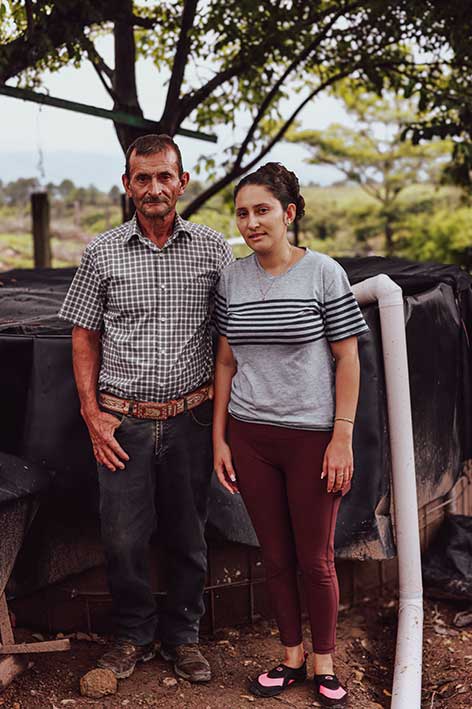
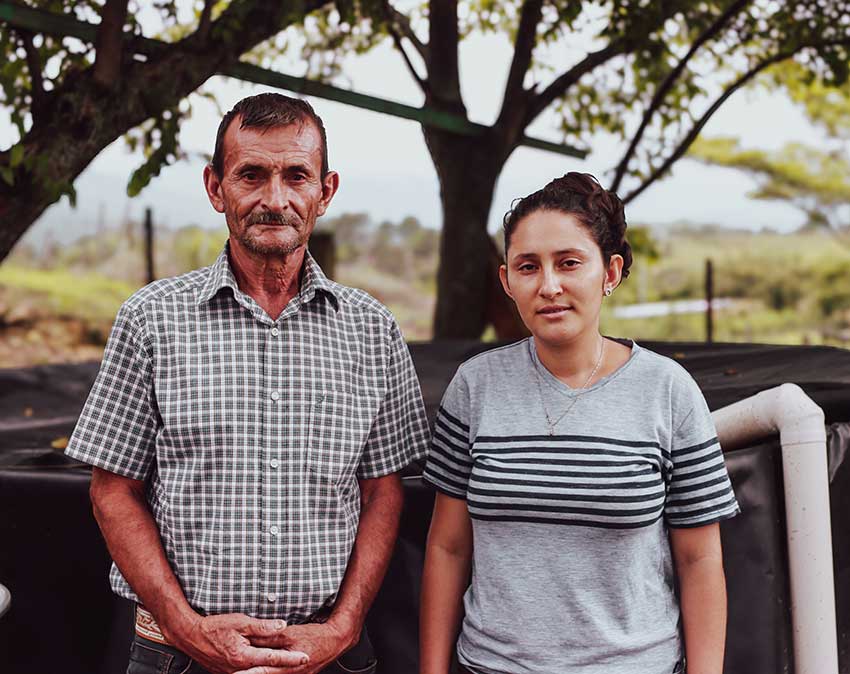
Lesly Morán Galdámez is 27 years old and lives in La Labor, Ocotepeque, Honduras. Together with her mother, Dina Galdámez, and her father, Héctor Morán, they work in livestock production in a region marked by prolonged droughts.
Ensuring that the cattle remain in good condition to obtain daily production of cheese and milk for sale and household consumption has required Lesly and Dina to organize their time between domestic work and long journeys to move the livestock from one place to another in search of water and food.
It is precisely here where the partnership between ESCALAR and the Mancomunidad de Güisayote created the enabling conditions for both Lesly and Héctor to receive training and build the first Zamorano tank implemented by ESCALAR in the community.
“We participated in trainings; they explained everything to us, the benefits of the tank, and from there they provided us with the materials for the construction,” said Lesly, who decided to actively join all training spaces, motivated by the field technician.
ESCALAR’s training and work methodology made it possible to replicate this construction on other nearby properties, always with constant support from the technician to address any challenges that might arise.
As a result of the project’s support, Lesly has gained access to capacity-building spaces and now plays a leading role in the family’s productive activities. Additionally, the Zamorano tank has allowed the family to have constant access to water for domestic tasks, and during the dry season, it also serves as storage for potable water provided by the municipality.
Now, Lesly and her parents dream of building a greenhouse behind their home. With the tank, they will be able to irrigate the grass, which will eventually allow them to keep the livestock much closer, reducing travel time for her and her family.
About the Series
This is the first story in a series produced by ESCALAR. It demonstrates how the project’s work is benefiting rural women—from the implementation of agricultural innovations for adaptation in communities vulnerable to climate change, to the creation of spaces that strengthen their leadership.
To access the ESCALAR project’s Gender Strategy, visit this link.
More information/written by:
Fernanda Carrillo Chacón
Gender, equity and human rights specialist in rural areas
ESCALAR Project – CATIE
fernanda.carrillo@catie.ac.cr