• About CATIE
    • Our Essence
    • Mission, vision and values
    • Strategic Vision
    • Authorities
    • Strategic alliances and projects
    • Institutional transparency
    • CATIE Campus: A Space for Restoration
  • Research for development
  • Education
    • Oferta Académica
    • Conózcanos
    • Graduate School
    • Capacitación continua
    • Financing
    • Virtual Campus
    • Online payment
  • Our commercial offer
    • Commercial Farm
    • Botanical Garden
    • Forest Seed Bank
    • Biotechnology Laboratory
    • CATIE Specialty Coffee
    • Accommodation at CATIE
    • “Repurpose with purpose”
  • CATIE in the region
    • Belize
    • Bolivia
    • Colombia
    • Costa Rica
    • Ecuador
    • El Salvador
    • Guatemala
    • Haiti
    • Honduras
    • Mexico
    • Nicaragua
    • Panama
    • Peru
    • Dominican Republic
    Have any question?
    (00) 123 456 789
    hello@eduma.com
    • Spanish
    • CATIE in press
    • Library Services
    • Employment
    • Licitaciones

    CATIE
    • About CATIE
      • Our Essence
      • Mission, vision and values
      • Strategic Vision
      • Authorities
      • Strategic alliances and projects
      • Institutional transparency
      • CATIE Campus: A Space for Restoration
    • Research for development
    • Education
      • Oferta Académica
      • Conózcanos
      • Graduate School
      • Capacitación continua
      • Financing
      • Virtual Campus
      • Online payment
    • Our commercial offer
      • Commercial Farm
      • Botanical Garden
      • Forest Seed Bank
      • Biotechnology Laboratory
      • CATIE Specialty Coffee
      • Accommodation at CATIE
      • “Repurpose with purpose”
    • CATIE in the region
      • Belize
      • Bolivia
      • Colombia
      • Costa Rica
      • Ecuador
      • El Salvador
      • Guatemala
      • Haiti
      • Honduras
      • Mexico
      • Nicaragua
      • Panama
      • Peru
      • Dominican Republic

      News

      • Home
      • Blog
      • News
      • PARES Project brings territorial experiences to the regional dialogue at COP4 of the Escazú Agreement
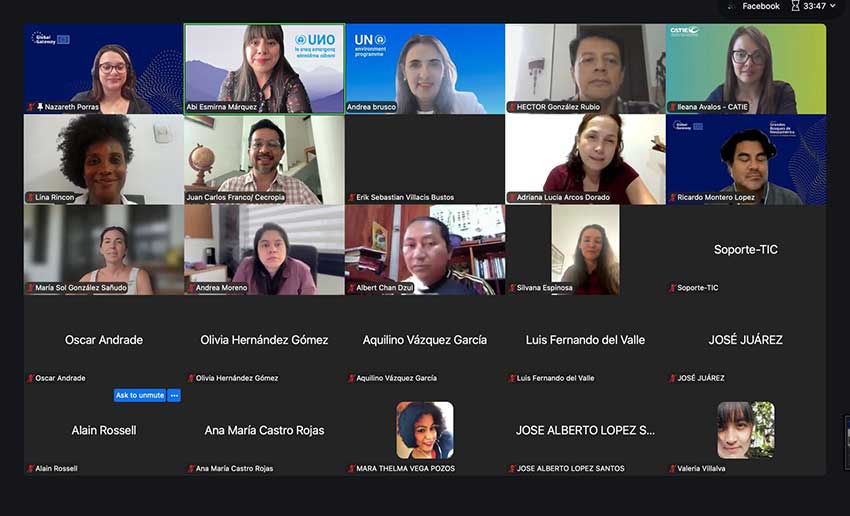
      PARES Project brings territorial experiences to the regional dialogue at COP4 of the Escazú Agreement

      • Posted by Karla Madrigal P.
      • Categories News
      • Date 27 April, 2026
      • Participation highlighted how participatory processes in territories across Latin America contribute to operationalizing access rights in contexts of climate change and socio-environmental tensions.

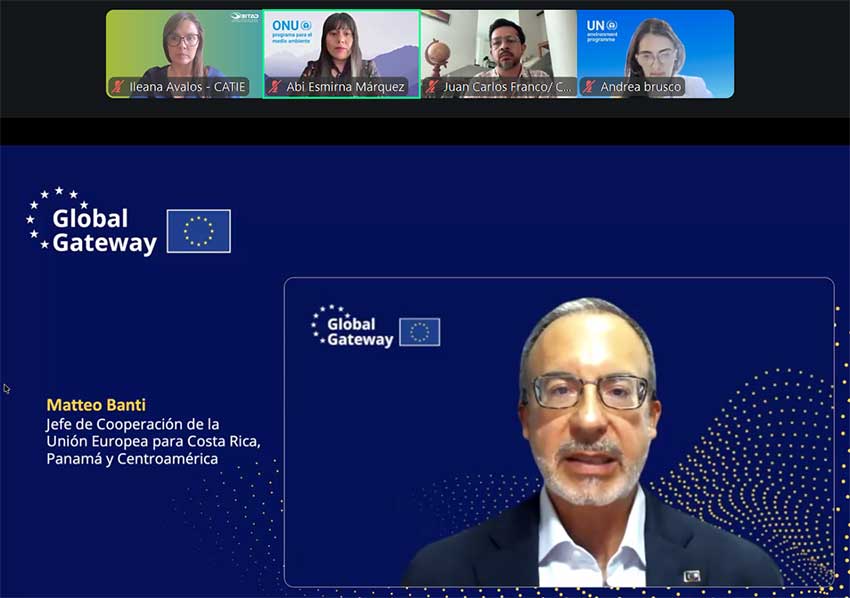
      Within the framework of the Fourth Conference of the Parties (COP4) of the Escazú Agreement, the project Peace, Action, Resilience and Sustainability in Latin American Landscapes (PARES), implemented by CATIE (Tropical Agricultural Research and Higher Education Center) in collaboration with the United Nations Environment Programme (UNEP), contributed to the regional dialogue on the implementation of access rights to information, participation, and decision-making in contexts of climate change, conflict, and territorial governance.

      The space enabled the connection of concrete field experiences with the principles promoted by the Escazú Agreement, demonstrating how these rights can be put into practice through structured participatory processes.

      The PARES project operates in six countries—Mexico, Guatemala, El Salvador, Honduras, Colombia, and Ecuador—strengthening local capacities for territorial analysis, the design of Nature-based Solutions (NbS), and their articulation with decision-making spaces. In addition, it represents the first operation in Latin America under the EU–UNEP partnership on Climate, Environment, Peace and Security.

      From landscapes to governance: lessons from practice

      During the event, experiences were shared that demonstrate how participatory processes enable communities to identify threats, make power relations visible, and name socio-environmental conflicts, thereby creating conditions for more effective participation in decision-making.

      The cases presented from Mexico and Colombia showed how these processes make historically excluded actors visible, open spaces for dialogue in contexts of tension, and transform the design of solutions according to territorial dynamics.

      These lessons highlight that participation is not limited to a formal mechanism but rather constitutes a process that can have a tangible impact on territorial governance.


      Implications for the implementation of the Escazú Agreement

      Based on the analysis, it was emphasized that the risks faced by territories are systemic and interconnected, and that Nature-based Solutions generate differentiated contributions depending on the context. In this scenario, governance—in terms of who participates and how decisions are made—is a determining factor.

      The discussion opened a key reflection for the public policy arena: how to ensure that these processes, which are already making the rights of the Escazú Agreement operational in territories, can be scaled up and contribute to the formulation and implementation of policies at the national level.

      In this way, the participation of the PARES project in COP4 contributed to strengthening the dialogue between territorial experiences and regulatory frameworks, highlighting the role that governments can play in institutionalizing these approaches.

      More information/written by:

      Ileana Ávalos Rodríguez
      PARES Project Coordinator
      Climate Action Unit
      CATIE
      ileana.avalos@catie.ac.cr

      (Visited 1 times, 9 visits today)

      Tag:Escazú Agreement, gobernanza territorial, participación comunitaria

      • Share:
      Karla Madrigal P.

      Previous post

      CATIE Director General presents on the impact of TR4 at ACORBAT 2026
      27 April, 2026

      You may also like

      TR4-1
      CATIE Director General presents on the impact of TR4 at ACORBAT 2026
      23 April, 2026
      analisis-datos-1
      CATIE advances its technical update series in data analysis for tropical agricultural research
      22 April, 2026
      IMG_9888 ae
      Multisectoral dialogue drives roadmap to reduce pesticide use in Costa Rican coffee
      22 April, 2026

      Search

      Categories

      • CATIE IN PRESS
      • EMPLOYMENT
      • Events
      • News
      • Noticias Guatemala
      • Noticias institucionales
      • Noticias Posgrado

      CATIE IN PRESS


      (506) 2558-2000


      comunica@catie.ac.cr


      Facebook-f


      Twitter


      Instagram


      Wikipedia-w


      Linkedin-in


      Youtube

      Suscribe

      • Sitemap
      • Contact
      Utilizamos cookies con el fin de ofrecer, mejorar, proteger y promocionar nuestros servicios.Al hacer clic en "Aceptar todo", acepta el uso de TODAS las cookies. Sin embargo, puede visitar Configuración de Cookies para proporcionar un consentimiento controlado.
      RechazarAceptar todo
      Manage consent

      Privacy Overview

      Este sitio web utiliza cookies para mejorar su experiencia mientras navega por el sitio web. De estas, las cookies que se clasifican como necesarias se almacenan en su navegador, ya que son esenciales para el funcionamiento de las funcionalidades básicas del sitio web. También utilizamos cookies de terceros que nos ayudan a analizar y comprender cómo utiliza este sitio web. Estas cookies se almacenarán en su navegador solo con su consentimiento. También tiene la opción de optar por no recibir estas cookies. Pero la exclusión voluntaria de algunas de estas cookies puede afectar su experiencia de navegación.
      Necessary
      Always Enabled
      Necessary cookies are absolutely essential for the website to function properly. These cookies ensure basic functionalities and security features of the website, anonymously.
      Functional
      Functional cookies help to perform certain functionalities like sharing the content of the website on social media platforms, collect feedbacks, and other third-party features.
      Performance
      Performance cookies are used to understand and analyze the key performance indexes of the website which helps in delivering a better user experience for the visitors.
      Analytics
      Analytical cookies are used to understand how visitors interact with the website. These cookies help provide information on metrics the number of visitors, bounce rate, traffic source, etc.
      Advertisement
      Advertisement cookies are used to provide visitors with relevant ads and marketing campaigns. These cookies track visitors across websites and collect information to provide customized ads.
      Others
      Other uncategorized cookies are those that are being analyzed and have not been classified into a category as yet.
      SAVE & ACCEPT